Monday, November 06, 2006

Sudan to face isolation, if Darfur crisis not swiftly ended - Blair

Sudan to face isolation, if Darfur crisis not swiftly ended - Blair

Nov 7, 2006 (LONDON) — Prime Minister Tony Blair said Monday that if Sudan’s government does not make progress in the next few weeks in stopping violence in Darfur and promoting peace talks, Britain, the European Union and the United States will have to find other ways to end the crisis.
Speaking at his monthly news conference, Blair said this is the message that he gave Salva Kiir Mayardit, Sudan’s first vice president, during his visit to London on Oct. 31, and asked him to take it back to Sudan’s leader.
Blair told Kiir, a former leader of Sudan’s southern rebels, that Sudan’s government has one last chance to move toward ending the conflict, or it will face international isolation. Kiir has publicly disagreed with Sudanese President Omar al Bashir over Bashir’s refusal to accept U.N. peacekeepers, one of the conditions the British government has said Sudan must accept.
Blair has urged fellow European leaders to exert "maximum pressure" on Khartoum to ease fighting in the violence-wracked region, where a three-year-old war has left some 200,000 people dead and 2.5 million displaced. Sudan’s government is accused of unleashing brutal militiamen known as janjaweed in the remote western region.
The U.N. has authorized 20,000 troops to replace an under-equipped force of 7,000 African Union peacekeepers in Darfur. But the Sudanese government has rejected the U.N. force and expelled the U.N.’s Sudan envoy, Jan Pronk.
Asked about his meeting with Kiir, Blair said Monday that he told him: "There is no desire whatever to have the U.N. force take over Sudan, change the government, or bring members of the government before the International Criminal Court. ... It is a simple desire to stop the displacement of people and the death of people in Darfur, and in order to do that — since the government of Sudan has been unable to do it — we need an external force."
Blair said such a force could stop the violence so Sudan’s government could try to bring all the parties involved into a negotiated settlement.
"There are other things in the news at the moment, but this is not off our agenda all, not here, not in the U.S., not in Europe," Blair said. "This is an important issue, and in the next few weeks we will have to have some form of progress, or we will be looking for other ways to resolve this."
Blair recently discussed Darfur with U.S. President George W. Bush, U.N. Secretary-General Kofi Annan and German Chancellor Angela Merkel in London.

Sunday, November 05, 2006

Darfur refugees flee to find stability in an unstable world

Darfur refugees flee to find stability in an unstable world

NYALA, Sudan — There is a camp called Otash that grows bigger every day, even as some displaced people elsewhere in Darfur get to go home because their villages are now calm. Here, people fleeing the war arrive by the truckload, 200 per truck, standing up to maximize space, packed in like corn.
They come from all parts of Darfur, for word is out that there is food and water and safety here. One of the first camps, it now has about 60,000 people.
A drive through the camp, which is on the outskirts of the city of Nyala, is like a journey through the entire Darfur tragedy, in which we see the stages of the conflict laid out spatially, one after another.
We begin at the oldest part of the camp, where the huts are made of mud brick and lined up in neat rows, almost like little streets. Some houses have fences and even small yards where a few crops struggle in the crunchy soil. These folks came in early 2004, when Darfur had not yet pricked the Western conscience and the horse-riding outlaws known as Janjaweed were killing and raping at will.
The refugees from these raids decided to stay and build themselves a village that resembled home. Most people are dressed in clean clothes. The colors are amazing: women in yellows and pinks and electric blues, men in white turbans and long white shirts.
The next section of the camp feels not quite as permanent. It is essentially a shantytown, stinking of garbage and waste water that pools in slimy ditches. The homes here are ungainly things made from straw and plastic tarps and scraps of cardboard. You can tell the people here are still hedging. They are not taking the time to put together a proper house because they are thinking this is all temporary, this life can't last, soon we'll go back home.
You can't blame them. Darfur is a world of mixed signals, with people moving in both directions, from villages to camps and from camps back to villages, depending on the security in their area. But even those who have returned say they are still scared.
Then comes a strange area, a field of small shelters, little bubbles no more than 2 feet off the ground that look like humped shells, made of plastic bags and twigs, barely big enough for curled-up children. No one is around, leading residents to suspect that perfectly able residents from town sneak into the camp and put up these minimal shelters to pass as displaced people so they can get free food and sell it in the market. Or maybe that explanation is just camp politics. There seems to be a lot of that, too.
And then there's the last area, the place for the new arrivals, a meadow of sorts that marks the edge of the camp where the shanties stop and the land opens up into sorghum fields that look metallic under the glinting sun.
Those here are the victims of the latest violence, the violence that seems to be unstoppable.

Some new arrivals are busy, trying to build shelters quickly to get their children out of the sun or covered up by nightfall. They are not too ambitious, often just planting sticks in the ground and stretching a shawl between them.
Other new arrivals sit motionless, staring at their few possessions spilled out in the grass — their "luggage" as people here call it, an apt translation for the few things you can carry when running for your life.
These people are the most lost. They have arrived. But they have nothing really to unpack.
A young woman sits by herself with her baby. She has not built her shelter yet. She has a few things — a battered plastic jerrycan, a charred pot blacker than charcoal, a small supply of dried okra and a mat.
Her husband has been killed and she has come with the others, packed in like corn. She is not talking to anyone.
There is nothing to say, either, no questions to ask.

White House drops support for UN peace force in Darfur

White House drops support for UN peace force in Darfur
AFP, WASHINGTON
In a major policy reversal, Wash-ingot’s special envoy for Sudan has confirmed the US is backing away from demands for deployment of a UN peacekeeping force to halt what it has called genocide in the the war-torn region of Darfur.
Andrew Natsios, US President George W. Bush's personal envoy to Sudan, said Washington and other Western governments were looking for an "alternate way" to deal with the violence in Darfur which has left at least 200,000 people dead and 2.5 million homeless in the past three-and-a-half years.
It was the first public admission that the US was reconsidering its backing for an Aug. 31 UN Security Council resolution, which Washington sponsored, demanding the immediate deployment of some 20,000 UN troops to replace an ineffective African Union peacekeeping force in Darfur.
Sudanese President Omar al-Beshir rejected the UN demand and refused to meet with Natsios during a visit to Khartoum last week, the US envoy said in an interview with the US National Holocaust Memorial Museum which was posted on the memorial's Web site on Friday.
Natsios said Beshir was furious over Bush's renewal last week of US financial sanctions imposed on Sudan for its handling of regional conflicts, including Darfur, and alleged support for international terrorists.
"They were quite upset about [it], so much so that they canceled my meeting with President Beshir," he said.
At a White House meeting with Natsios on Wednesday, Bush said he was reviewing the US approach to the Darfur crisis, described as the first genocide of the 21st century, but he refused to provide details.
A UN-brokered peace agreement signed in May with one of the rebel groups brought hope for an end to the carnage, but ultimately failed when other groups refused to sign.
Since then government-allied forces have renewed offensives in the region, with the UN reporting on Friday that scores of civilians had been massacred in refugee camps in the region over the past few days.
Under pressure from European allies and human rights groups, Secretary of State Condoleezza Rice made Darfur a major US foreign policy priority in the middle of this year, insisting that only a UN "blue-helmeted" force would have the financial and political clout to stop the killing.
But Besher has refused to budge.
At a summit of African leaders in Beijing on Friday, the Sudanese leader said accepting UN troops in Darfur would lead to a debacle similar to Iraq.
Natsios now says the UN role is no longer essential.
"Our real interest here is not what it is called or what it looks like in terms of its helmet, but how robust and how efficient it is," he said.
Washington could accept either a strengthened African Union force or one led by Arab or Muslim nations, possibly backed by UN financial or logistical support, he said.
Another element of the new US approach is to use African mediation -- Natsios mentioned Eritrea as a potential go between -- to renegotiate the May peace agreement in a bid to draw in other rebel groups.
The prospect of a policy turnaround was assailed as "shameful" by one former US official involved in the issue.
"If where we're headed now is some sort of appeasement or accommodation with the government of Sudan so they can yet again cherry pick and constrain a new peacekeeping force, we really are complicit in failing to stop this second wave of genocide," said Susan Rice, the State Department's top Africa official under the Clinton administration.

Friday, November 03, 2006

Sudanese Rebels Kill 63 In Scattered Attacks Around Darfur

Sudanese Rebels Kill 63 In Scattered Attacks Around DarfurNovember 3, 2006
Nji Che - All Headline News African Correspondent
Khartoum, Sudan (AHN) - Pro-government militias have killed at least 63 people in attacks launched around Sudan's Darfur region in the past week.
African Union peacekeepers say more than 27 children under the age of 12 were among those killed.
The attacks occurred around the rebel stronghold of Jebel Moun, in West Darfur. The Janjaweed militia reportedly swept through camps in Jebel Moun on October 29. A team of African Union investigators just returned from the area.
The BBC quotes the National Redemption Front's (NRF) alliance, Bahr Idriss Abu Garda as saying, "The government have begun mobilizing the Janjaweed widely, especially in West Darfur, because they want to clear the area and move north along the border and defeat us." The NRF is a rebel faction that spurned the May peace accord.
In August, the U.N. Security Council voted to replace the underpowered African Union peacekeeping mission with a robust U.N. force. But that hasn't happened. President Omar al-Bashir and his ruling National Congress Party (NCP) have rejected the resolution.
Khartoum claims accommodating a 20,000-man U.N. force would breach Sudan's sovereignty. Bashir also rejected an offer from Arab countries that proposed deployment of Arab and Muslim troops to the regime last month.
Fighting in Darfur, where several rebel factions oppose Sudanese troops and pro-government militia, has escalated since then.
International aid agencies estimate at least 200,000 people have died, while more than 2.5 million others have been uprooted from their ancestral land since fighting erupted in 2003.

Sudan Rejects Blair Warnings Over Darfur Crisis

Thursday, November 02, 2006

Chinese president urges to maintain Darfur stability


Chinese president urges to maintain Darfur stability
Nov 2, 2006 (BEIJING) — China hopes the Sudanese government can strengthen dialogue with each concerned party in the Darfur conflict and try to maintain stability in the region, Chinese President Hu Jintao told his Sudanese counterpart Thursday.
China understands the Sudanese government’s concerns over the Darfur issue, Hu said when meeting Sudanese President Omer Hassan Ahmed al-Bashir, who is here for the Beijing Summit of the Forum on the China-Africa Cooperation scheduled for Nov. 4-5.
"We hope the Sudanese government can find an appropriate settlement, maintain stability, and constantly improves the humanitarian conditions in the region," Hu said.
China will continue to make contributions to an early realization of peace and stability in Darfur, Hu said.
Briefing Hu on the current situation in Sudan, Al-Bashir said the Sudanese government is seeking an effective cooperation mechanism with African Union (AU) and will make efforts to settle the Darfur conflict in a peaceful way.
Hu said that the Chinese government will push forward the bilateral ties to a new level on the basis of mutual respect and benefit.
The two countries should strengthen cooperation in the fields of communications, infrastructure construction, agriculture and water conservancy, Hu said.
China and Sudan forged diplomatic relations on Feb. 4, 1959. Chinese President Hu Jintao met with al-Bashir in 2005 on the sidelines of Asia-Africa Summit. Bilateral trade topped 3.9 billion U.S. dollars in 2005.
The Darfur conflict erupted in February 2003 when rebels took up arms against the government, accusing it of marginalizing the region.
The Sudanese government has rejected a United Nations plan to send a 20,000-strong peacekeeping force to Darfur to replace the AU troops, but reiterated its commitment to full cooperation with the UN for improving the humanitarian situation in the region.
In view of Sudan’s persistence in its refusal, the AU decided on Sept. 20 to extend the mandate of its 7,800-strong forces in Darfur to the end of this year after it expired on Sept. 30, urging the world community to provide assistance for the cash- strapped African forces.

Wednesday, November 01, 2006

Darfurian People Met The First Minister Of Scotland


Darfurian People Met The First Minister Of Scotland

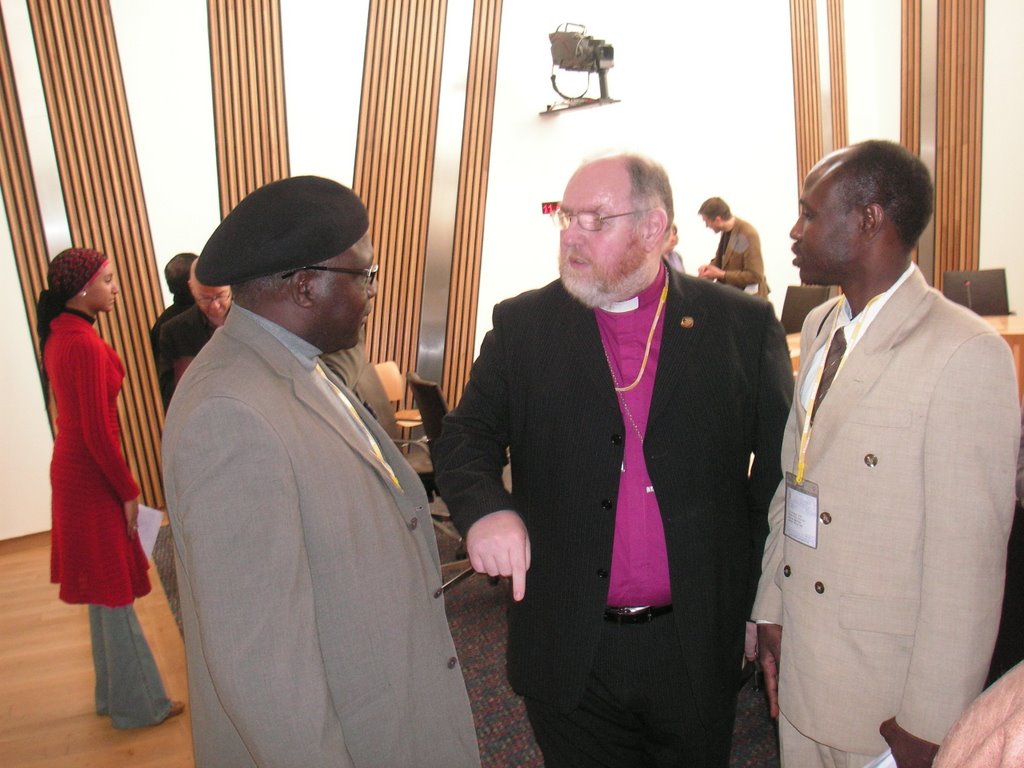
In continuation of thier effort to explain the dimensions of the Darfur issue . Mr Elhadi Abdullah abudafair chairman of the Sudan Liberation Movement in Scotland and Mr Malik M Norinen chairman of the Darfurian Union in Scotland met the First Minister of Scotland, and explained to him the deterioration of the miserable humanitarian situation in the region and lack of security for Darfur people . they also clarified that raping, looting, killing of innocent civilians and attack on villages by Janjaneed Militia and government troops is still going on .
They appealed to him to continue putting pressure on the Sudanese government to consent to international troop deployment and the implementation of UN resolution 1706 so as to protect the civilians in the region .

Tuesday, October 31, 2006

Sudan Liberation Movement inside the Scotland Parliament


Sudan Liberation Movement inside the Scotland Parliament


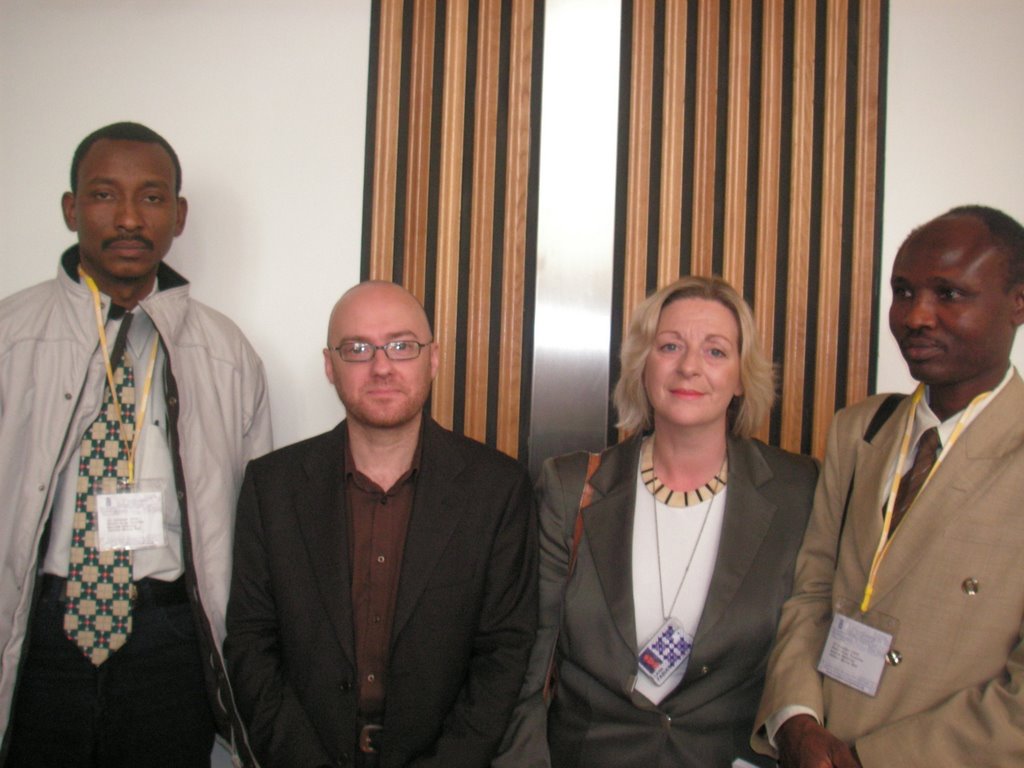
In a sustained effort and planned struggle to explain the just cause of Darfur and project facts before decision-makers, SLM chapter senior officials in Scotland; Mr. Alhadi Abdullah Abudafair, chairman and Mr. Al-Rabae Adam Ezaldeen, Secretary-General and Mr. Nur Eldin Abdullah khalil, SLM chapter spokesman conferred with a group of parliament deputies and decision-makers whom they briefed on the deteriorating humanitarian situation in Darfur, absence of security and the regime of Khartoum non-compliance with the UNSC Resolution 1706 to protect the innocent civilians. They have touched on the regime defiant conduct indicates the continuation of its ethnic cleansing policy which will worsen the situation especially following the expulsion of Mr. Pronk, UN special representative to Sudan.

The SLM officials urged the deputies and decision-makers to exercise further pressure on the international community to put into effect the UNSCR 1706 and accelerate the deployment of international forces to protect the people of Darfur and live up to its obligations toward the people of Darfur.


Information Committee
Tel: 008821666677532


Sudan Liberation Movement in Scotland in a political symposium

Mr. Alhadi Abdullah Abudafair, chairman of SLM chapter in Scotland in a political symposium organized at Quality hotel in Glasgow city addressed a large audience of citizens, representatives of political parties and students’ unions. The event took place with the presence of Mr. Al-Rabae Adam Ezaldeen, SLM chapter Secretary-General and Mr., President of the Union of the People of Darfur in Scotland. It’s worth mentioning that the symposium was organized by the Scotland Social Party (Solidarity) and SLM chapter participated in response to official invitation extended to it by the organizers in solidarity with the people of Darfur.

We have strongly reiterated that we are resolved to stay the course to fully restore the rights of our people and establish justice, democracy and freedoms. Moreover, we will avail any political, cultural and social platform to cast lights on the just cause of the people of Darfur who have suffered a lot from war, displacement and genocide carried out by the national conference regime and its militias.

The Glasgow university students’ union has extended its invitation to the SLM chapter’s executive staff to reflect the crisis in Darfur, the SLM vision as well as its instruments to resolve the problem in Darfur. We will make that information available soon.

Long live and victory to our revolution.
Information Committee
Tel: 008821666677532


Sudan Liberation Movement in a huge protest


In a remarkable day filled with vivid activities, SLM chapter chairman, secretary-general and spokesman in Scotland participated, in response to official invitation from the organizing entities, in a huge protest organized by Glasgow Campaign To Welcome Refugees. They availed that opportunity to speak to various media and press organizations on the plight of Darfur.

Monday, October 30, 2006

SUDAN: Government still seeking military solution in Darfur, Pronk says

SUDAN: Government still seeking military solution in Darfur, Pronk says

NEW YORK, 30 Oct 2006 (IRIN) - In his briefing to the United Nations Security Council on Friday, the UN’s top official in Sudan, Jan Pronk, highlighted the government’s gross violations of the Darfur Peace Agreement and stressed that Sudan was still looking for a military solution to the deepening crisis. Pronk added that his ongoing criticism of the Sudanese government’s decision to seek a military solution, having signed a ceasefire agreement, had prompted his expulsion from his position of UN Special Representative for the Secretary-General in Sudan. "The government is mobilising more and more forces in the region, amongst others, those coming from the south. Security Council resolutions forbidding offensive air operations are being neglected," he told council members in what he characterised as "probably" his last briefing to the council. To illustrate, Pronk cited a meeting he had held with rebel commanders in Birmaza, where he implored leaders to stop looting aid vehicles, and to stop attacking the African Union Mission (AMIS), which is in Darfur until the end of December. "Now that the UN is giving support to AMIS, I will consider any attack on AMIS an attack on the UN," he told the rebels. They immediately undertook not to attack government troops, but were bombed by the Sudanese government air force within 14 hours of his departure. "I consider this characteristic of the present attitude," he said.The 7,500-strong AMIS force had its mandate extended until December 2006 by the AU Peace and Security Commission, as the Sudanese government has continually refused to accept UN peacekeepers in the region, even after a council resolution was adopted calling for UN troop deployment.UN Under-Secretary-General for Political Affairs, Jean-Marie Guehenno, also briefed the council and spoke to reporters on the continuing UN efforts to strengthen AMIS."There has to be a political process, and the United Nations stands ready to engage as it has done, to engage further to promote the political process in Darfur and support the efforts of the African Union," said Guehenno.During consultations, the council discussed the fear that the situation in Darfur would spill over to other parts of the region, including eastern Chad. Guehenno announced an upcoming UN mission to Chad and the Central African Republic to see what could be done to help more than 50,000 internally displaced people and 200,000 refugees in eastern Chad alone."We are looking at ways in which a peace operation could prevent the tragedy of Darfur from expanding further [to create] a bigger tragedy in Chad and the Central African Republic," said Guehenno.Pronk, who was also concerned about the possible regional impact of Darfur, had been asked to leave Sudan by the government on 22 October due to his web-blog comments, in which he characterised the Sudanese armed forces as having low morale and indicated that the forces had recently lost several battles.Addressing reporters after the council meeting, Pronk said he believed the government’s decision to expel him was due to his criticisms "of the fact that the government continued to fight, to seek a military solution, despite the fact a ceasefire agreement had been signed; despite the fact that the DPA [Darfur Peace Agreement] had been signed", adding that he was also critical of the ceasefire violations of the rebel movement. "My incessant criticism of this was the reason for them to silence me," he added. "I have one request for the council. Please stay alert and remain attuned. After all the sorrow in Sudan, in the south as well as in Darfur, the people over there, neglected and oppressed for decades, should not be forgotten in the turbulence of other world affairs. They are counting on you," he concluded.Stéphane Dujarric, UN spokesman, outlined plans for Pronk’s return. "Following ongoing consultations with the Sudanese authorities, it is expected that Mr Pronk will return to Khartoum during November to organise an orderly handover to the officer in charge of the UN mission before returning to New York for debriefings and the completion of his mission," he said. When asked whether the UN had received an official response from the Sudan government, Dujarric said, "We do not expect any problems with the scenario that has been laid out." No official date has been set yet for his trip.Sudanese Ambassador Abdalmahmood Abdalhaleem, however, denied this, saying: "This issue for us is over and we are not backtracking from our decision; no arrangement was worked out with us," he said. "People should really respect our sovereign position."

Sunday, October 29, 2006

Sudanese First Vice-President to London Sunday


Sudanese First Vice-President to London Sunday

Oct 30, 2006 (KHARTOUM) — Sudanese First vice-president will start one-week visit to the United Kingdom where he is expected to hold talks about peace implementation and Darfur crisis.
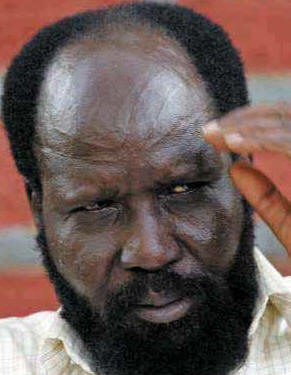
The First Vice - President and President of Government of Southern Sudan, Salva Kiir Mayadrit, is due to leave Sunday for London on a several-day visit to Britain.
Kiir would meet in London with the Prime Minister Tony Blair, Foreign Secretary Margaret Beckett and International Development Secretary Hilary Benn.
Kiir is expected to discuss implementation of the Comprehensive Peace Agreement signed between the SPLM and the Sudanese government in January 2005. The question of the pledged international aid to southern Sudan construction will be debated with British official.
Sources indicated that Tony Blair is eager to discuss Darfur crisis with the Sudanese First Vice President who has a different stance on UN forces deployment in Darfur.
Salva Kiir will hold a meeting with the Sudanese community in Britain.
The visit is the first of its kind since assuming his post.
Chad says Sudan airforce bombards eastern towns

Oct30, 2006 (N’DJAMENA) — Chad on Saturday accused Sudan’s air force of bombarding four towns along its eastern frontier and said its armed forces were ready to repel further attacks.
President Idriss Deby’s government said Sudan on Friday bombed the towns of Bahai, Tine, Karyari and Bamina, destroying homes and sowing panic among residents. It did not give any information on casualties.
"The government expects the African Union ... and the United Nations to condemn this bombardment of peaceful Chadian citizens and for them to work to stop the repeated Sudanese attacks against Chad," a statement from the government spokesman Hourmadji Moussa Doumgor said.
"In the face of this escalation of Sudanese aggression, all necessary steps have been taken to permit security and defence forces to carry out their responsibilities," he added.
The accusation came only days after Chad accused Sudan of backing an incursion this week by a heavily-armed rebel convoy deep into its territory.
The rebels of the newly-formed Union of Forces for Democracy and Development (UFDD) briefly seized two towns as they penetrated into central Chad, before retreating eastward. The government says they have sought refuge in Sudan.

Saturday, October 28, 2006

Darfur Peace & Development Organization

Darfur Peace & Development Organization
For Immediate Release:


Since the Darfur crisis erupted in 2003, the Government of Sudan, the perpetrator of genocide, has been concealing crimes they and their proxy militia have committed against the people of Darfur. The international community has adopted several resolutions for deploying peacekeeping forces to Darfur, however Sudan's ruling party shaped the mandate and the mission of the African Union Forces in its favor. The government continues to oppose all efforts to resolved the Darfur crisis, with the intention to continue criminal activity to achieve its goals, its so-called "civilization projects" that were planned nearly two decades ago. All people in Darfur are counting on the United Nations for protection and advocacy on their behalf. The UN Secretary General's Special Representative in Sudan, Mr. Jan Pronk has been expelled from the country. The regime has thus deprived the international community of a dependable communications link. US Secretary of State Condoleeza Rice stated clearly to the government of Sudan: cooperate or face confrontation. Unfortunately, Sudan's regime has chosen confrontation with the United Nations, the very organization that provides many kinds of support for the Darfur people. Darfur Peace and Development condemns this unwise behavior of the Government of Sudan. The United Nations now has no choice but to lift its will and exert its power against Sudan's government -- including economic embargoes and targeted sanctions against Sudanese leaders. United Nation must send troops to Darfur. And the people of Darfur are again caught in the crossfire.

Friday, October 27, 2006

Expelled UN envoy to Sudan to be replaced by deputy

Expelled UN envoy to Sudan to be replaced by deputy
Oct 28, 2006 (UNITED NATIONS) — The top U.N. special envoy to Sudan will be replaced by his deputy when his contract expires at the end of the year, a U.N. spokesman said Friday, days after the diplomat was ordered to leave Sudan because of postings on his Web blog.
Jan Pronk, who was to address the U.N. Security Council later Friday about the situation in the violence-plagued Darfur region of Sudan, was expected to return to Khartoum next month to organize the handover, U.N. spokesman Stephane Dujarric said.
Dujarric said U.N. Secretary-General Kofi Annan still has full confidence in Pronk, the U.N.’s special representative in Sudan for more than two years.
"However, he also realizes that at a critical time in the Darfur negotiations, it is important that we preserve a good working relationship with the government of Sudan," Dujarric said at a news conference.
On Sunday, the government gave Pronk three days to leave after he accused the Sudanese army of mobilizing Arab militias in the Darfur region following heavy losses in recent fighting with rebels.
The Sudanese military denounced Pronk’s allegations, branding them " psychological warfare against the Sudanese army," claiming he had demonstrated " enmity to the Sudanese government and the armed forces."
Earlier this week in the Netherlands, Pronk said he had merely repeated details on his Web blog that he had read in a local newspaper.
Pronk said he had offended elements within the Sudanese government "who continue to seek a military solution and don’t want anybody peering over their shoulders."
The order for Pronk to leave heightened a dispute between the U.N. and the Khartoum government over peacekeeping in Darfur. Sudan has refused to allow U.N. peacekeepers to replace a poorly equipped African Union force that has been unable to halt escalating violence in the vast western region.
Violence has risen dramatically in recent weeks in Darfur, where more than 200,000 people have been killed and 2.5 million displaced in more than three years of fighting.
(AP)

Sudanese ambassador: U.N. envoy 'abused his authority'

Sudanese ambassador: U.N. envoy 'abused his authority'
UNITED NATIONS (CNN) -- The Sudanese ambassador to the United Nations lambasted the body's chief envoy to Sudan on Thursday for insulting the country's government and army on a Web blog.
"He abused his authority, his mandate," Abdalmahmood Mohamad said of envoy Jan Pronk.
Pronk "was not faithful to the mandate of the United Nations," Mohamad said. "He lost his impartiality and integrity in the country. He became part of the problem rather than the solution.
"For all these reasons, he left the government with no other choice but to ask for his replacement," Mohamad added.
Mohamad met with U.N. Secretary-General Kofi Annan on Thursday.
On Sunday, the Sudanese government gave Pronk 72 hours to leave the country after he criticized Khartoum as well as rebel groups on his blog. (Full story)
Pronk has sharply criticized the Arab-dominated Sudanese government, which unleashed Arab militias known as Janjaweed into Darfur about three years ago. The Janjaweed are accused of systematically raping women and killing scores of non-Arab in villages throughout Sudan.
On Monday, Secretary of State Condoleezza Rice called Sudan's decision to expel Pronk "unfortunate in the extreme."
The Bush administration has labeled the crisis a genocide.
"The plight of the people in Darfur is the making of the Sudanese," Pronk told CNN Correspondent Jeff Koinange in an interview Wednesday. "The people have been forgotten, neglected, marginalized. The government is responsible for using the army and Arab militia, which kill and kill and do not abide by any rule, let alone human rights rules."
Pronk drew sharp criticism from the Sudanese military this month after blogging that government forces had suffered serious losses recently at the hands of rebels in Darfur.
In an October 14 blog entry, Pronk wrote: "First, the SAF [Sudanese Armed Forces] has lost two major battles -- last month in Umm Sidir and this week in Karakaya. The losses seem to have been very high. Reports speak about hundreds of casualties in each of the two battles with many wounded and many taken as prisoner."
"The morale in the government army in North Darfur has gone down. Some generals have been [fired]; soldiers have refused to fight," the Dutch diplomat said.
On Thursday, Mohamad said Pronk was not truthful about the army, saying that Pronk relied on unverified third party accounts.
Pronk was sent to Sudan to try to convince the government and rebel factions to comply with a peace agreement signed about five months ago.
A U.N. resolution approved August 31 authorized the creation of a more robust, better-equipped U.N. peacekeeping mission. But Sudanese President Omar Hassan al-Bashir has refused to accept such a force, saying it would violate his country's sovereignty.
Pronk has urged countries to push for a prolonged and beefed-up African Union force.
An estimated 200,000 Sudanese have been killed and more than 2 million displaced in the Darfur province in western Sudan since the conflict began, according to the United Nations. An African Union peacekeeping force has been unable to stop the violence.
"More than 2 million people in camps. You can say that Darfur has been cleansed," Pronk said in the CNN interview. "The international community took action too little and too late."
He added: "For many people, it is too late. They cannot be salvaged anymore because they have been killed, they have raped, atrocities have taken place with impunity in this part of the country."

Thursday, October 26, 2006

Pronk still envoy to Sudan despite explusion- UN

Pronk still envoy to Sudan despite explusion- UN
Oct 23, 2006 (UNITED NATIONS) — U.N. envoy Jan Pronk, who angered the Sudanese government by saying morale was low in the army, enjoys Secretary-General Kofi Annan’s full confidence despite a government order that he quickly leave the troubled African country, the United Nations said on Monday.
Sudanese Foreign Ministry officials told Pronk on Sunday that the government considered that his mission was over and he had 72 hours to leave the country. He was headed back to New York as of Monday.
The order came after he posted comments on his Web log (www.janpronk.nl) stating that the army’s morale was low after suffering two major defeats in the violent Darfur region.
But chief U.N. spokesman Stephane Dujarric, speaking at U.N. headquarters, said Pronk had only been called to New York for discussions and "continues to be the special representative of the secretary-general."
Pronk still serves "with the full support of the secretary-general," Dujarric said. "As far as we are concerned, his status remains unchanged."
Pronk’s latest blog entry said Darfur rebels had beaten the army in two major battles in the last two months. He said generals had been sacked, morale was low and soldiers were refusing to fight in North Darfur.
Dujarric would not say whether the incident had complicated efforts to move a U.N. peacekeeping force into Darfur to replace a smaller, ill-equipped African Union force now there.
He also would not say whether Annan had spoken to Pronk about the contents of his blog or whether rules were needed to limit what U.N. staff can say on personal blogs.
Annan "has fairly liberal rules in terms of staff members being able to write or speak freely, but obviously they need to exercise the proper judgment in doing so," Dujarric said.
Pronk, 66, a former Netherlands cabinet minister and member of parliament, was named the U.N. special representative for Sudan in June 2004.
He is known in Sudan for dedication to his job but also for his blunt comments, which irked some parties. He has been outspoken about Sudan’s refusal to allow the U.N. force into Darfur despite mounting violence in recent months.
U.S. Secretary of State Condoleezza Rice, in Washington, called the expulsion order "unfortunate in the extreme" while Kent Dagerfeld, the European Union ambassador in Sudan, urged the government to reconsider its decision.
U.N. peacekeeping officials were meeting Sudan’s U.N. ambassador later on Monday and Pronk was expected to brief the U.N. Security Council on the expulsion order on Wednesday.
(Reuters)

Tuesday, October 24, 2006

Mr, alrabae adam ezaldeen


Mr, alrabae adam ezaldeen
Asking un and us to Help stop the genocide in Darfur!

Every day, the 2.5 million people chased from their homes in Darfur face the threat of starvation, disease, and rape, while the few lucky enough to remain in their homes risk displacement, torture, and murder. Therefore, I call on you to do the following:

1. Push for the immediate deployment of the already-authorized UN peacekeeping force.

2. Strengthen the understaffed African Union force already in Darfur until the UN force can be deployed.

3. Implement a fair and lasting Peace Agreement.

4. Increase humanitarian aid and ensure access for delivery.

Rift between UN, Sudan deepens with envoy's expulsion

Rift between UN, Sudan deepens with envoy's expulsion

Jan Pronk flew out of Khartoum yesterday following his expulsion by the Sudanese government that effectively ended his two-year stint as United Nations secretary-general Kofi Annan's special representative.
Pronk's expulsion deepens the rift between President Umar al-Bashir's government and the international community over demands that Sudan allow UN peacekeepers into Darfur to help halt violence that has killed as many as 200,000 people and driven two million more from their homes.
"It's looking increasingly grim how Sudan and the UN can patch this up," Anoushka Marashlian, Middle East analyst at Global Insight, a consultant and forecasting company, said today in a telephone interview from London.

Monday, October 23, 2006

Britain slams expulsion of UN envoy from Sudan


Britain slams expulsion of UN envoy from Sudan
Oct 24, 2006 (LONDON) — Britain government on Sunday expressed condemnation of Sudan’s request for United Nations envoy Jan Pronk to leave the country, describing the step as "counter-productive".
Lord Triesman, FCO Minister with responsibility for Africa, today condemned the announcement by the Government of Sudan that they were expelling the UN Secretary-General’s Special Representative to the country.
He said "The British Government condemns the decision to expel the UN Secretary-General’s Special Representative to Sudan. This step is counter-productive and will contribute nothing to solving the problems of Sudan. I call upon the Government of Sudan to reconsider its decision."
The Sudanese government Sunday ordered the chief U.N. envoy to leave the country within three days after he wrote that the Sudanese army had suffered serious losses in fighting with rebels in northern Darfur.
Pronk said in a press statement issued in Khartoum that the Sudanese foreign ministry informed him that his “mission as Special Representative of the United Nations Secretary-General in the Sudan terminated” and that he is “requested to leave the territory of the Republic of the Sudan within 72 hours effective 12:00 noon of Sunday 22 October 2006.
Sudan’s government has been at odds with Pronk over Western efforts to get Sudan to allow a U.N. force of 20,000 troops to take over peacekeeping in Darfur — a move President Omar al-Bashir has flatly rejected as a bid to restore colonial rule.
Tension between the government and Pronk escalated after he wrote in his personal Web blog this month that Sudanese army losses in recent fighting in northern Darfur "seem to have been very high."
(ST)

Sunday, October 22, 2006

Holocaust Survivors Call For Help In Darfur


Survivors of the Holocaust along with survivors of genocide in Rwanda, Cambodia and Bosnia are calling upon the European Union to help end the violence in Darfur. The call for help is backed by six aid agencies but the EU’s response was that they can only send peacekeeping forces and the Sudanese government refuses to allow such a group into Darfur. Thus far, African military has been unable to end the violence which has caused around 2 million people to flee their homes since 2003. According to a BBC report, ‘Studies estimate at least 200,000 people have died during the conflict, in which pro-government Arab militias are accused of committing a genocide against Darfur’s black African population.’
Darfur is suffering death at the hands of pro-government Arab militias who are killing the black Africans. Sudan claims that reports are exaggerated, much in the way that Germany and Hitler denied the Holocaust. Mean while, it seems the world is standing by allowing yet another mass genocide unfold in Africa. Additionally, news reports leave many wondering what exactly is the genocide in Darfur?
With most of Darfur’s population being Muslim, strong opposition has arisen in the area between the Muslim and African populations. The Sudanese government has stated that it will view European Union or United Nations peace-keeping intervention as, ‘foreign invaders’ even in the midst of death toll predictions that range anywhere from 50,000 to 400,000, with the later being the number most human rights and humanitarian groups believe to be true. Critics (including the Coalition for International Justice) blame a lack of world response in the form of insufficient funds and insufficient equipment. After all, since when has a rogue government’s decree that no help be allowed in, stopped nations such has the U.S. from intervening?
There undoubtedly exists an alarming crisis in Darfur which cannot stand to be ignored any longer. UNICEF calls the on-going deaths there, ‘senseless’ and calls for a stop of fighting from both sides. It seems there is little hope of either side giving up, while innocent families and more so, children, are lost in a war without an end.

Saturday, October 21, 2006

UN suspends repatriation of Sudanese refugees from Uganda


The UN refugee agency UNHCR on Friday temporarily suspended repatriation of southern Sudanese from Uganda following the killing of at least 38 civilians in a string of attacks in southern Sudan.
In a statement issued in Nairobi, the UNHCR said it "Friday temporarily suspended return convoys from northern Uganda to southern Sudan following reports on Thursday that unknown gunmen killed at least 38 civilians in a string of attacks in southern Sudan."
"We will be monitoring the security situation closely before deciding when to resume the repatriation convoys," the statement said.
The Ugandan army confirmed that people were killed in a series of ambushes mounted by gunmen on the wooded roads of southern Sudan, prompting the Ugandan government to halt all traffic destined to the vast region. The Ugandan government blamed LRA guerrillas for the attacks.
Since last December, UNHCR has voluntarily repatriated 14,000 southern Sudanese from neighboring countries, including 4,500 from Uganda.
The signing of a Comprehensive Peace Agreement in January 2005 ended 21 years of war in the southern Sudan and paved the way for the return of millions of internally displaced people and refugees in surrounding countries.
Source: Xinhua

Friday, October 20, 2006

Darfur Sun

McGovern urges student involvement in battle against genocideU.S. Rep. James McGovern talks about genocide in Dafur at Dean College in Franklin yesterday. (Rick Holland photo)FRANKLIN -- It is this generation’s Holocaust, according to U.S. Rep. James McGovern, but he says it remains a struggle to get the world to wake up to the genocide which has claimed the lives of an estimated 200,000 people in the Dafur region of Sudan -- Africa’s largest country.

"The only way things will change (in Darfur) is if we demand that things change," McGovern told a group of about 50 Dean College students and faculty yesterday. "This horror is not going to end on its own."

McGovern, D-3rd, has been an outspoken voice in drawing attention to the civil war between the Sudanese military dictatorship government, and rebel forces which got their start in Darfur, staging an uprising from the region in 2004.

The fighting has caused as many as 2.5 million refugees to either be chased or evicted from their homes, has led to huge migrations and the creation of makeshift tent cities with populations of 120,000 in some cases.

The congressman said his young children, ages five and eight, will learn about world history over time. Part of his motivation to become involved in defeating the genocide in Sudan, he said, was being able to have an answer for his children when they get older.

"It’s not too far of a stretch to imagine them asking me, ’Dad, what did you do when you saw the genocide against the people of Darfur?’" McGovern said. "And I want to be able to tell them I did something."

Sharing recommendations for actions needed to address what he called the "greatest human rights crisis of our time," McGovern said 7,000 African Union peacekeeping troops covering an area the size of France, must have their mission extended past a Dec. 31 pullout deadline.

He also said despite the Sudanese government’s resistance to the idea, 20,000 similar peacekeeping forces, assembled by the United Nations, should be deployed immediately.

"Once those troops leave, all hell’s going to break loose, even worse than it is now," McGovern said.

Additional humanitarian aid and the imposition of a no-fly zone over Sudan were other steps McGovern said should be taken without delay.

He acknowledged, however, that it has been tough to gain traction at a time when the primary foreign affairs focus is on the war in Iraq. As a way to keep attention on the atrocities being committed in Darfur, McGovern described his civil disobedience arrest last spring, after he refused to leave the Sudanese Embassy in Washington, D.C., and was temporarily jailed for doing so.

Yet he said he was joined in the protest by only three other members of Congress. Meanwhile, the front page of McGovern’s own Web site does not mention Sudan or Darfur.

"We could all be doing more to fight this," he said.

He was also critical of the world’s tepid response to the crisis in Sudan. "It really says something about the lack of political will in the world," McGovern said. Closer to home, he said a shrugged shoulders response from Americans was a betrayal of the national conscience.

"If (the genocide) is allowed to continue, we should remove the words ’never again’ from the Holocaust Museum," McGovern said.

On a more hopeful note, McGovern told his audience yesterday that individual actions could make a difference. He noted that the will of the people had brought an end to conflicts such as the Vietnam War and the practice of apartheid in South Africa.

"If I can leave here with one message, it’s to join in this effort," McGovern said, before directing people who want to learn more to the Web site www.savedarfur.org.

His comments appeared to have an effect on students after the presentation yesterday. While she directed questions to McGovern about domestic issues, Nicole Consigli, the college’s Student Government Association president, said the congressman’s visit had helped her appreciate needs on a global scale.

"He helped me see that it’s really up to us, people in my generation, to take the initiative to get involved if we’re going to change the world," Consigli said.

Rick Holland can be reached at rholland@cnc.com or 508-634-7505.